Beyond the Eleventh Guru: A Field Guide to the Puratan Granths
Most of us grew up knowing exactly one Sikh book: Sri Guru Granth Sahib Ji. That is as it should be — the Granth is the Guru, and nothing else in Sikh literature shares its throne. But around that throne stands a court: a whole library of puratan (old) granths from the Gurus’ time and the Panth’s classical age, from which Sikhs drew their history, their code of conduct, their battle-poetry and their hope. Most Sikhs today have heard these names — Dasam Granth, Sarabloh Granth, Suraj Prakash, Prem Sumarag, Sau Sakhi — without ever being told what’s actually inside them, whether they may read them, or where a beginner could possibly start.
This post is the guide I wish someone had given me. One orientation before we begin, and it settles ninety percent of the anxiety around these texts: Sri Guru Granth Sahib Ji alone is the Guru. The granths below are the treasured literature of the Guru’s own darbar and of the Panth — the Tenth Master’s bani, history, rahit, poetry, prophecy. You don’t have to choose between revering the Granth and reading these; the Panth has always done both, the way you can love your mother and still read the family’s letters.
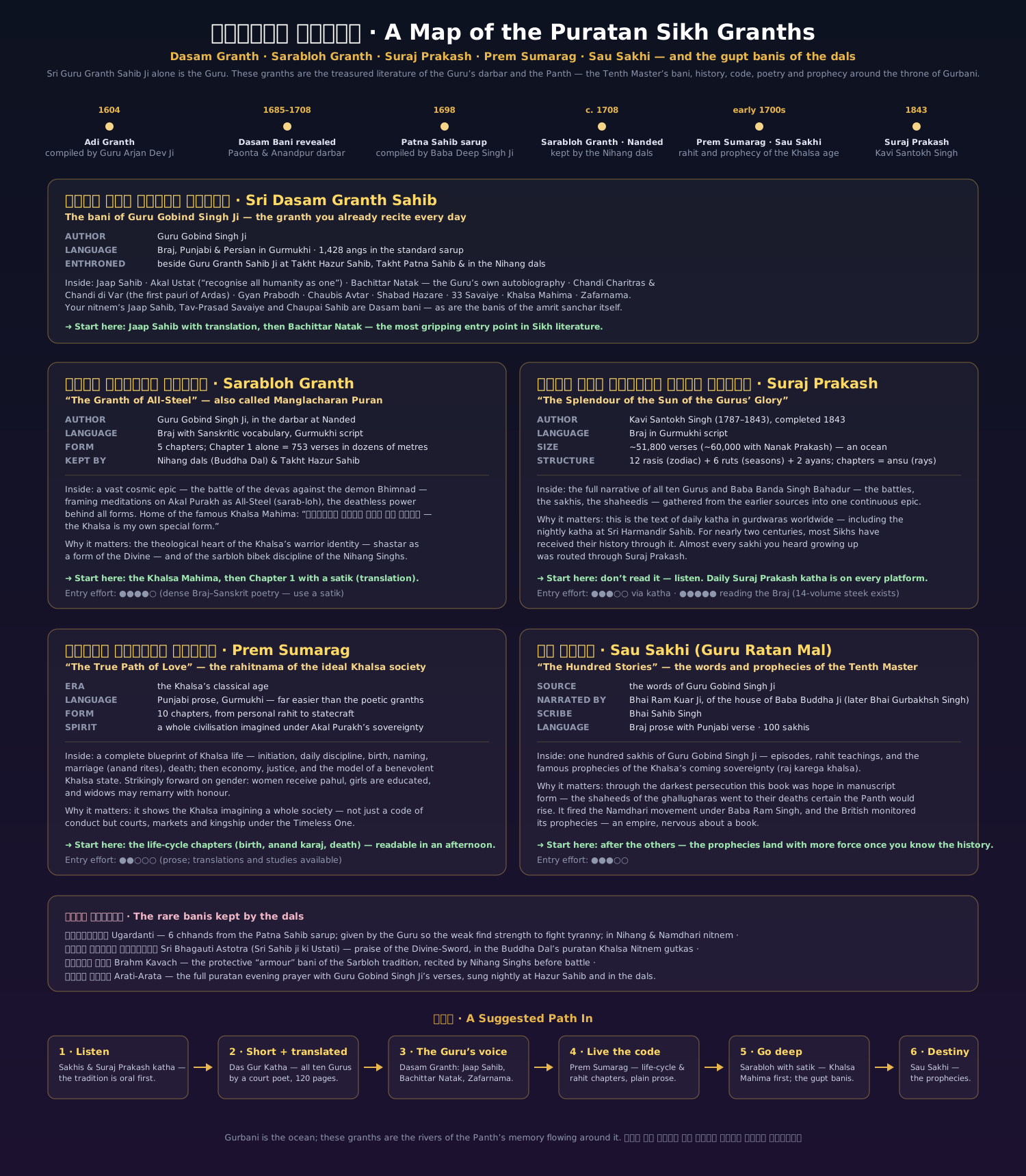
Here’s the map — the full post below walks through each text:
Sri Dasam Granth Sahib — the Tenth Master’s own voice
Bani of Guru Gobind Singh Ji · Braj, Punjabi and Persian in Gurmukhi · 1,428 angs in the standard sarup
What it is. The collected bani of Guru Gobind Singh Ji — and the granth every practising Sikh already knows more of than they realise. Your daily nitnem draws directly from it: Jaap Sahib, Tav-Prasad Savaiye, and Chaupai Sahib are all Dasam bani, as are the banis of the amrit sanchar itself. The Ardas — the prayer that opens with ਪ੍ਰਿਥਮ ਭਗੌਤੀ ਸਿਮਰਿ ਕੈ — begins with the first pauri of Chandi di Var, the Guru’s thundering ballad of the Divine-as-sword. If you have ever stood in Ardas, you have recited Dasam Granth.
What’s inside. Jaap Sahib, the cascade of the Names of the Nameless; Akal Ustat, the praise of the Timeless One (“ਮਾਨਸ ਕੀ ਜਾਤ ਸਬੈ ਏਕੈ ਪਹਿਚਾਨਬੋ — recognise all humanity as one”); Bachittar Natak, the Guru’s own autobiography — the only autobiography of a Guru we possess — including his account of his father’s shaheedi; the Chandi Charitras and Chandi di Var, where the Guru takes the war-Goddess of the old epics and forges her into a metaphor of divine power destroying tyranny — the same fire that inspired warriors like Mai Bhago; Gyan Prabodh; the Chaubis Avtar narratives of Rama and Krishna retold under the sovereignty of Akal Purakh; Shabad Hazare; the 33 Savaiye; Khalsa Mahima — ਜੁੱਧ ਜਿਤੇ ਇਨਹੀ ਕੇ ਪ੍ਰਸਾਦਿ, “these battles I have won by the grace of these [Khalsa]”; and the Zafarnama, the Persian letter of victory to Aurangzeb, moral defiance written by a man who had just given four sons: ਚੁ ਕਾਰ ਅਜ਼ ਹਮਹ ਹੀਲਤੇ ਦਰ ਗੁਜ਼ਸ਼ਤ, ਹਲਾਲ ਅਸਤ ਬੁਰਦਨ ਬ ਸ਼ਮਸ਼ੀਰ ਦਸਤ — “when all other means have failed, it is righteous to draw the sword.”
Why it matters. The Dasam Granth is the engine-room of the Khalsa: the theology of shakti-in-bhakti, the martial imagination, the initiation rite, half the nitnem. At Takht Hazur Sahib and Takht Patna Sahib, and in every Nihang dal, it is enthroned alongside Sri Guru Granth Sahib Ji, and its katha and santhia have been taught in an unbroken line since the Guru’s darbar.
Where to start. With what you already know: read a translation of Jaap Sahib slowly, once, and it will change how you hear it at amritvela. Then Bachittar Natak (the Guru telling his own story is the single most gripping entry point in Sikh literature) and the Zafarnama in translation.
The gupt banis — the rare compositions kept by the dals
Beyond the standard sarup, the puratan recensions and the gutkas of the dals preserve compositions most Sikhs have never heard of — sometimes called gupt (hidden) banis, not because they are secret, but because their custody remained with the Nihang dals and the sampradayas while the printing presses standardised everything else. Four are worth knowing by name. Ugardanti — found in the Patna Sahib sarup, whose compilation tradition goes back to Baba Deep Singh in 1698 — is six chhands invoking the fierce-toothed Mother-as-sword; by Nihang tradition the Guru gave this bani to the weak so they would find the strength to fight tyranny, and it remains part of Akali Nihang and Namdhari daily liturgy. Sri Bhagauti Astotra (officially Sri Sahib ji ki Ustati — “praise of the Sword”) is an invocation of the Adi Shakti found in the same puratan recensions and in the Buddha Dal’s old Khalsa Nitnem gutkas. Brahm Kavach — the “armour of Brahm” — is the protective bani of the Sarbloh tradition, recited by Nihang Singhs before battle and to this day in the dals’ nitnem; the old Singhs would not ride out without it. And the full puratan Arati-Arata — the evening prayer most Sikhs know only in its short form — continues in the dals with its complete sequence of verses by Guru Gobind Singh Ji, sung nightly at Hazur Sahib and in the Buddha Dal. If you want to hear the Khalsa’s soundscape as the eighteenth-century shaheeds heard it, these four banis are the door.
Sri Sarabloh Granth — the theology of steel
Bani of Guru Gobind Singh Ji · Braj bhasha in Gurmukhi · 5 chapters · kept by the Nihang dals and Takht Hazur Sahib
What it is. The “Granth of All-Steel,” also known by its older name Manglacharan Puran. The frame-story is a vast cosmic war — the devas against the demon Bhimnad — but the frame carries the granth’s real subject: Akal Purakh contemplated as sarab-loh, All-Steel, the indestructible power behind and within every form. In this vision, weapons are not tools; shastar are a saroop (form) of the Divine, which is why Nihang Singhs bow to their weapons and why the marriage of bhagti and shakti — devotion and power — is the Khalsa’s signature. The colophon of Chapter 1 gives the flavour, in English translation: “revealing the divine experience, illuminating purity and praise, dispelling the darkness of ignorance… the destruction of the filth of Kaliyug and Bhimnad.”
Its most famous passage is the Khalsa Mahima — the highest praise of the Khalsa anywhere in Sikh literature — where the Guru declares ਖ਼ਾਲਸਾ ਮੇਰੋ ਰੂਪ ਹੈ ਖ਼ਾਸ: “The Khalsa is my own special form… I live within the Khalsa.” When Sikhs say the Guru resides in the Panth, this is the locus classicus. The tradition places its composition in the Tenth Guru’s darbar in the Deccan, at Nanded, and the Buddha Dal — its custodian for three centuries — includes it alongside Guru Granth Sahib and Dasam Granth in its akhand paths. Its place in Khalsa practice — sarbloh bibek, the battle-standards of the dals, the kirtan-darbars at Hazur Sahib, the Brahm Kavach — is living, not archival.
Where to start. Not page one. Read the Khalsa Mahima first — it’s short and electrifying — then work through Chapter 1 (753 verses, the Manglacharan Puran proper) with a satik. Dr Kamalroop Singh’s ongoing English satik, with the Gurmukhi, transliteration, and copious footnotes on the weapons, metres and mythology, was written precisely to lower this barrier; his site has an entire Sarbloh Granth Sahib section.
Sri Gur Partap Suraj Granth (Suraj Prakash) — the Panth’s memory palace
Kavi Santokh Singh · completed 1843 · Braj in Gurmukhi · ~51,800 verses
What it is. The largest and most consequential history of the Gurus ever written: the lives of all ten Gurus and Baba Banda Singh Bahadur, in roughly 51,800 verses — around 60,000 counting the earlier Nanak Prakash. Santokh Singh, trained at Amritsar under Giani Sant Singh, spent decades collecting the earlier sources — janamsakhis, Bhai Mani Singh’s traditions, the gurbilas literature — and versifying them into a single continuous epic.
Its structure alone teaches you something. The work is built as a poetic cosmos: the Gurus’ lives arranged into twelve rasis (zodiac houses) and six ruts (seasons) plus two ayans (solstices), with every chapter called an ansu — a ray of the sun. The Gurus are the sun; the book is sunlight, broken into eleven hundred rays. (The volume you have — “P10” — is one part of the Bhai Vir Singh 14-volume annotated edition, the standard scholarly text since the 1930s.)
Why it matters more than any book you haven’t read. For nearly two centuries, this has been the source of daily katha in gurdwaras — including the nightly katha at Sri Harmandir Sahib. Almost every sakhi you absorbed as a child — Guru Nanak and the cobra’s shade, the Sahibzade at Sirhind, Baba Deep Singh’s vow — reached you through a chain that runs through Suraj Prakash. It is, functionally, the Panth’s collective memory, and the katha tradition has read it aloud, with love and learned commentary, every single day for nearly two hundred years.
Where to start. Don’t read it — listen to it. Suraj Prakash katha (in Punjabi) is freely available: recordings of the Harmandir Sahib katha, and serialised katha by parcharaks, exist on every platform. Thirty minutes a day makes you fluent in your own history within a year. Readers can approach the Bhai Vir Singh steek or SearchGurbani’s online text.
Prem Sumarag Granth — the blueprint of a Khalsa civilisation
From the Khalsa’s classical age · Punjabi prose · 10 chapters
What it is. “The True Path of Love” — the most ambitious of the rahitnamas (codes of conduct). Where other rahitnamas give lists of do’s and don’ts, Prem Sumarag imagines an entire society: how a Khalsa takes pahul and lives daily discipline; how a child is born, named, married (with the anand rite) and cremated; how markets should run, how justice should be administered, how a benevolent Khalsa ruler should govern under Akal Purakh’s sovereignty. It is a rahitnama that grows into a constitution.
The part that should be famous. Its provisions for women are extraordinary for any pre-modern religious text: women receive khande di pahul, girls are to be educated, and widows may remarry with full honour — at a time when the surrounding society burned widows. The Panth was legislating gender in a direction the rest of the world reached centuries later. If you read only one chapter, read the life-cycle chapters with this in mind.
Where to start. This is the easiest entry point of all four granths — it’s prose, in Punjabi rather than Braj, and short (your PDF is a slim volume). The birth, anand karaj, and death chapters are readable in an afternoon and immediately illuminate why Sikh rites of passage look the way they do.
Sau Sakhi (Guru Ratan Mal) — the Panth’s book of destiny
The words of Guru Gobind Singh Ji, narrated by Bhai Ram Kuar Ji (descendant of Baba Buddha Ji, later Bhai Gurbakhsh Singh), recorded by scribe Bhai Sahib Singh · Braj prose with Punjabi verse · 100 sakhis
What it is. “The Hundred Stories”: the sayings and episodes of Guru Gobind Singh Ji as remembered by one who stood in his presence — Bhai Ram Kuar, of the house of Baba Buddha Ji, who had performed the tilak ceremonies of the Gurus for generations. It carries the Guru’s teachings on rahit, episodes from his life, and, most famously, the prophecies: visions of the Khalsa’s coming sovereignty, the fall of oppressors, the destiny of the Panth. This is the granth behind the raj karega khalsa conviction of the eighteenth and nineteenth centuries.
Why it matters. During the darkest persecution, this book was hope in manuscript form — Singhs in the jungles hearing that the Khalsa was destined to rule did not lack for motivation, and the shaheeds of the ghallugharas went to their deaths certain the Panth would rise. Its power carried straight into the colonial era: the Namdhari movement under Baba Ram Singh drew its anti-British fire from the Sau Sakhi’s visions, and the British themselves took its prophecies seriously enough to monitor their circulation — an empire, nervous about a book. Few Sikh texts have done more in history.
Where to start. After the others — the prophecies land with far more force once Suraj Prakash has given you the history they grew from. The sakhis on rahit and the Guru’s darbar are the gentlest entry.
And one more: Das Gur Katha, the perfect on-ramp
One more text belongs on this shelf — the one I’d actually hand a beginner first: Kavi Kankan’s Das Gur Katha, a short narrative of all ten Gurus by a court poet of Guru Gobind Singh Ji himself, available with Gurmukhi, transliteration and English translation (2024, 120 pages). It’s the witness of the Guru’s own darbar — the shaheedi of Guru Arjan, the founding of the Khalsa, the five reprobate groups, the promise that “the angels and demons will all lose against Your Panth” — small enough to finish in two sittings, and it cross-references beautifully against the Suraj Prakash’s fuller versions of the same episodes. Reading Kankan first and Santokh Singh second is like seeing a battlefield sketch by a soldier who was there, then the grand oil painting made later.
Cross-referencing in practice: one episode, three witnesses
To see why reading these texts together is worth the trouble, take a single episode: the events around the founding of the Khalsa. Kavi Kankan — a poet of the Guru’s own court — gives the earliest short witness: the demand for heads, khande ki pahul, kesh, and the naming of the five reprobate groups (Minas, Masands, Bhadanis, Dhirmalias, Kurimars) to be shunned. A century and a half later, Suraj Prakash narrates the same Vaisakhi at magnificent length, with the details the katha tradition knows. Sau Sakhi retells it again with the emphasis shifted toward destiny and coming sovereignty. Reading the three side by side, you watch the same truth told at three scales — what stays constant in every telling (pahul, kesh, the offered heads, the panj mel to be shunned) and what each poet’s lens brings out: Kankan the immediacy of a witness, Santokh Singh the grandeur of the whole, Sau Sakhi the destiny it set in motion. This is what cross-referenced reading gives you that no single text can: not less faith, but a three-dimensional view of it — like hearing the same shabad in three raags.
How these granths talk to each other
Read together, these granths form a complete curriculum, because each answers a different question. Dasam Granth answers who is the Khalsa — the Tenth Master’s own voice: the theology of shakti-in-bhakti, the nitnem, the autobiography, the Zafarnama’s moral fire. Suraj Prakash answers what happened — the narrative spine of all ten Gurus. Sarabloh answers what it means — the Khalsa as the Guru’s own form, power wielded in devotion. Prem Sumarag answers how then shall we live — from the naming of a child to the running of a state. And Sau Sakhi answers what is destined — the visions that kept the Panth alive when everything else was taken. Voice, history, theology, law, and destiny: that is the architecture of a whole civilisation’s library, and it all orbits Sri Guru Granth Sahib Ji, the sun at the centre that answers the only question above these — who is the Guru?
The barrier to entry was never that these texts are forbidden. It’s that nobody drew us a map. Consider it drawn — start with step one on the chart above tonight: put on a Suraj Prakash katha while you do the dishes. That’s it. That’s how the tradition always transmitted itself — katha first, granth later, love throughout.
ਧੁਰ ਕੀ ਬਾਣੀ ਆਈ॥ ਤਿਨਿ ਸਗਲੀ ਚਿੰਤ ਮਿਟਾਈ॥
Sources and further reading
- Kavi Kankan, Das Gur Katha, tr. Dr Kamalroop Singh (2024) — and the Sarbloh Granth Satik, Chapter 1 (2026)
- Dr Kamalroop Singh’s Sarbloh Granth Sahib, Dasam Granth Sahib and Papers pages
- Suraj Prakash — Wikipedia · Sri Gur Pratap Suraj Granth — The Sikh Encyclopedia · full text at SearchGurbani
- Prem Sumarag Granth — SikhiWiki · “The Path of Love: Prem Sumarag Granth” · Karamjit Malhotra, “Issues of Gender among the Sikhs: Eighteenth-Century Literature”
- Sau Sakhi — SikhiWiki · Sau Sakhi — The Sikh Encyclopedia
- Ugardanti — SikhiWiki · Sarbloh Granth — SikhiWiki · the Buddha Dal puratan gutka paper (Khalsa Nitnem, Ugardanti, Bhagauti Astotra) at kamalroop.com/papers
- Bhai Vir Singh (ed.), Sri Gur Partap Suraj Granth, 14 vols.